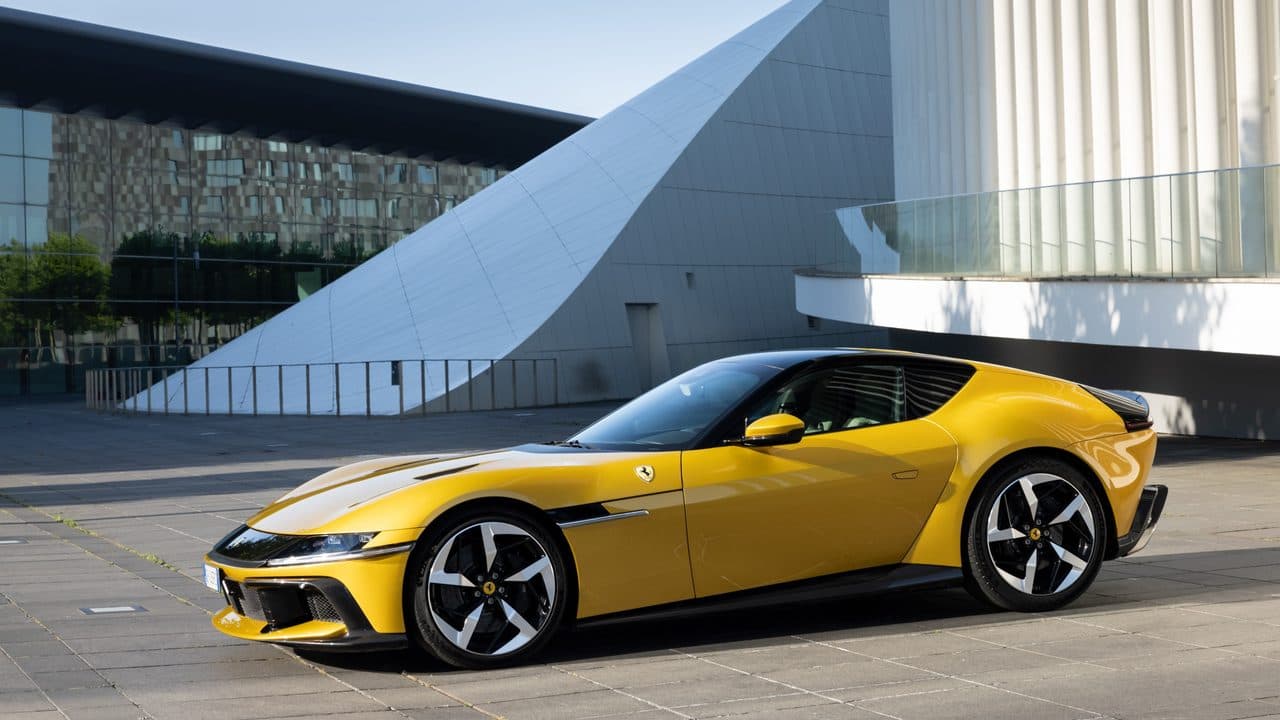
What it is
The last Ferrari V12 with a manual gearbox was the 599 GTB Fiorano, which ended production in 2012. Fourteen years later, the 12Cilindri Manuale brings back three pedals, a gated H-pattern shifter, and the particular satisfaction of slotting a lever into a metal gate while a naturally aspirated V12 climbs to 9,500 rpm behind the dashboard.
The catch: none of it is mechanically connected to the transmission. The underlying hardware is the same Magna 8DCL900 8-speed dual-clutch unit from the standard 12Cilindri. Ferrari has built a separate by-wire module on top of it, and that module is doing something genuinely clever.
How the Manuale By-Wire works
The gated shifter covers six forward gears plus reverse, using the first six ratios of the 8-speed DCT. Gears seven and eight are only accessible in automatic mode, which you can reach with one press of the R/N/D/L touch panel on the center console.
Two Hall-effect sensors read the lever's position on both axes. An electromagnetic solenoid acts as a lockout, physically blocking the gate if the transmission cannot accept the selected gear. A profiled rotating drum with a preloaded mechanism creates the tactile click of slotting into gear. The complete assembly weighs under 3.5 kg and is machined from solid billet steel.
The clutch pedal is new too. An angular position sensor measures pedal travel and translates it into hydraulic commands for the DCT's clutch packs. A passive system of springs, cams, and rollers recreates the resistance curve of a conventional clutch: effort builds as you release, then drops away at the simulated bite point.
The car can stall. Poor clutch-throttle coordination causes a real stall, just like a three-pedal car. Below 100 km/h, a hard clutch dump triggers an anti-stall safety net. Heel-and-toe downshifts work manually. There is no automatic throttle blip. There are no paddle shifters.
On startup, the car defaults to automatic mode. Pressing the clutch pedal activates manual mode, signalled by an amber glow around the gear gate.
The engine
The 6.5-litre F140-derived V12 is identical to the standard 12Cilindri. 830 CV (819 hp) at 9,250 rpm, 678 Nm (500 lb-ft) at 7,250 rpm, 9,500 rpm redline, 13.5:1 compression. An additional 5 hp is available through dynamic overboost on 98 RON fuel. Specific output: 128 CV per litre. No hybrid assistance, no turbocharging.
Performance: 0-100 km/h in 2.9 seconds, 0-200 in under 7.9, top speed over 340 km/h in automatic mode and 315 km/h in manual mode (limited by the six available ratios). Dry weight is 1,565 kg, roughly 5 kg heavier than the standard car.
1,499 units, effectively sold out
The production run of 1,499 is a reference to the displacement (in cubic centimetres) of Ferrari's first twelve-cylinder engine, built in 1947. Every car goes through the Tailor Made personalization programme. Coupe body only. No Spider variant.
Twenty-five heritage paint colours are available, including Rosso Rubino (the launch colour), Argento Nurburgring, Nero Daytona, Blu Pozzi, Bianco Mille Miglia, and Verde Zeltweg. Exterior details include laser-etched "Manuale" badges on the front wings, a monochromatic embossed scudetto produced using a coin-minting technique, and pinstripe detailing on the front splitter and active rear winglets referencing the 365 GTB/4 Daytona. Five-spoke forged 21-inch wheels are available in four finishes.
Base price is approximately 590,000 euros (around $675,000), roughly 190,000 euros above the standard 12Cilindri. Multiple outlets report the run is already fully allocated to existing clients. Deliveries begin early 2027.
Our take
The argument against the Manuale is that it is a costume on an automatic. The clutch pedal operates a sensor, not a cable. The gear lever moves solenoids, not synchromesh rings. The engine does not care which mode you are in.
The argument for it is simpler: a 9,500-rpm naturally aspirated V12 with a gated shifter, a clutch pedal, and the possibility of stalling it in front of a restaurant valet is the most Ferrari product specification anyone has written in a decade. Whether the mechanism underneath is by-wire or mechanical matters less than the fact that Ferrari built the thing at all.
The Manuale is a counterpoint to the Luce, Ferrari's first EV, revealed earlier this year. One is the future. The other is a 6.5-litre twelve-cylinder engine connected to a metal gate by electronics and conviction. Both are real cars. That is the strategy. See how the two ends of Ferrari's range stack up in our Ferrari 12Cilindri vs Ferrari Luce comparison, and where the 12Cilindri lands on our fastest cars list.
Photo: Ferrari
***
Sources: Ferrari 12Cilindri Manuale: the purest expression of driving (Ferrari).