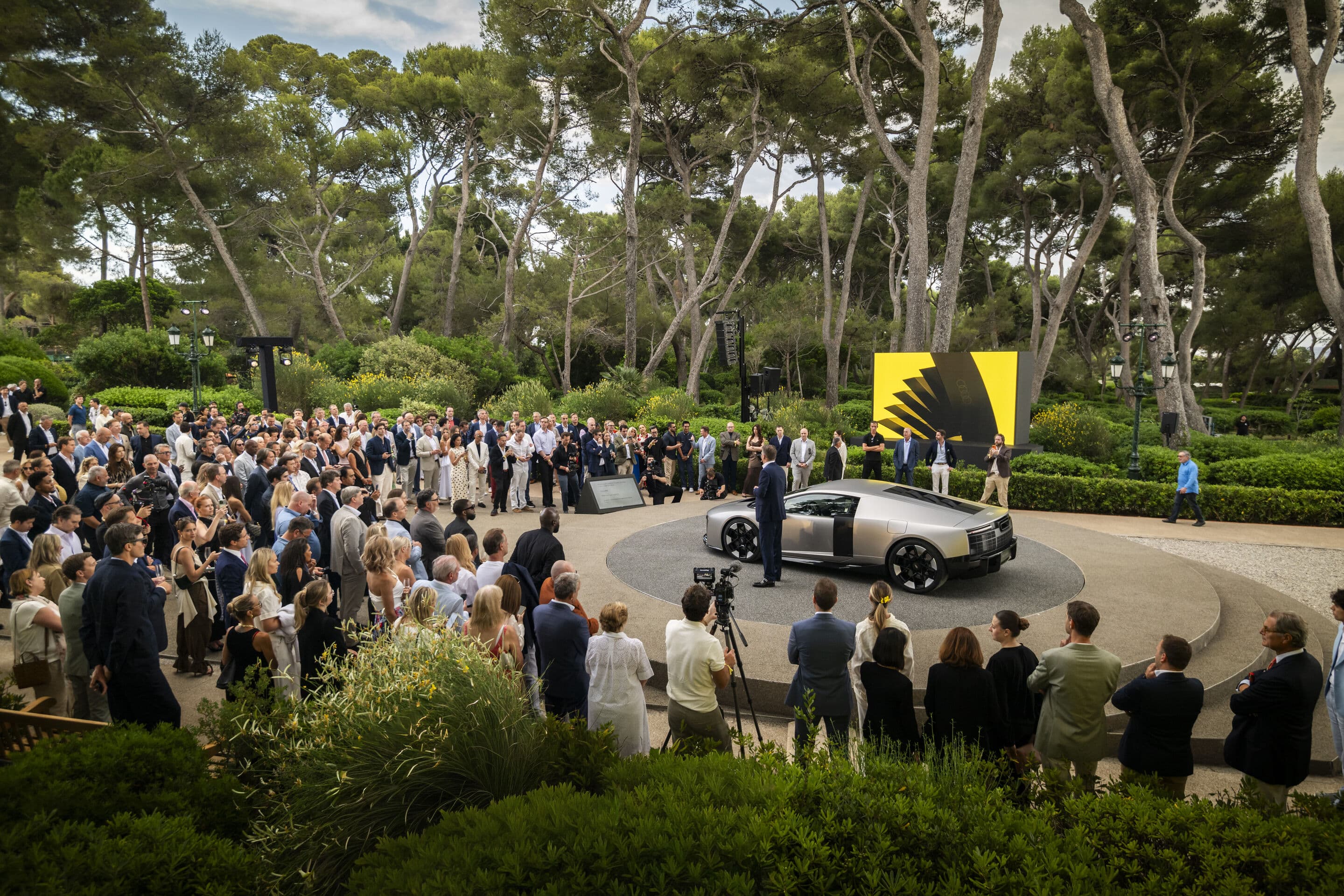
The R8 has been gone for two years
Production of the R8 ended in March 2024 at Böllinger Höfe after 17 years and 45,949 cars. The Lamborghini-shared chassis was retired. The 5.2-litre naturally-aspirated V10, one of the last great naturally-aspirated supercar engines, went with it. Audi has spent the intervening two years insisting a successor was coming. The Nuvolari is what was meant.
It is not a like-for-like replacement. The R8 was a series-production supercar that Audi could build, in theory, indefinitely. The Nuvolari is a 499-unit Few-Off with a price tag implied to be well north of anything Audi has charged before. Different intent, different platform, different name. What it inherits from the R8 is the position at the very top of the Audi range.
The fastest and most powerful production Audi ever built. A high-performance hybrid powertrain. A new architecture that has nothing to do with the Lamborghini-shared R8 chassis. Production capped at 499.
What the powertrain actually does
Audi's release confirms 1,001 PS combined system output. That's 988 hp for those of us who care about the PS-to-hp conversion, and we do. The Revline Drive catalog now corrects for it across every German halo we cover. See where it ranks on our most powerful cars list. It's the first supercar in Audi's history to use a plug-in hybrid powertrain, which is notable for a brand whose performance reputation was built on the naturally-aspirated V10 and the twin-turbo V8 in the RS6.
The exact configuration, meaning what kind of engine, how many electric motors, and where they sit in the car, is something Audi has been deliberate about not disclosing yet. What's confirmed: 1,001 PS, 350+ km/h top speed, and "high-performance hybrid." The implication is a mid-engine ICE block paired with at least one electric motor on the front axle (giving the Nuvolari AWD), perhaps two. Audi's recent RS5 reveal used a 2.9 TFSI V6 plus a 130 kW e-motor. The Nuvolari is presumably a bigger displacement engine plus a larger battery and motor pack.
What 499 units tells you
Audi's halos historically came in larger runs. The R8 GT (final generation) was 333 units globally. The R8 V10 plus GT RWD was 333 units. The R8 LMX (the LED headlight halo) was 99 units. The Sport Quattro of 1984, the closest historical analogue to what the Nuvolari is trying to be, was around 200 road cars.
499 sits in between "halo special" and "regular production supercar." It's the number Lamborghini used for the Veneno (3 coupes, 9 roadsters, a different ballpark), Pagani's regular production runs, and the kind of number Aston Martin reserves for AMR-engineered specials. It's small enough to be exclusive, large enough to recoup the development cost of a new platform.
The Nuvolari is sold out. All 499 deliveries are accounted for. If you wanted one, you needed to be on the Audi customer list before this announcement.
What this means for everything else
The Nuvolari is half a positioning move and half a roadmap signal. The positioning: Audi keeps a halo. The roadmap signal: that halo is now electrified. Every Audi performance car launched since 2024, including the new RS3, RS5, RS6 Performance final edition, and e-tron GT, has either been hybridized or fully electric. The Nuvolari confirms this is the direction at the top of the range too.
Audi's official line is that the brand will eventually return to "highly emotional models that shape the brand, like the iconic Audi TT, Audi A5 and Audi R8 once did." The Nuvolari is the first of that next chapter. Deliveries begin H1 2027.
Sources: Nuvolari supercar: Audi accelerates technological renewal (Audi MediaCenter). Audi presents its first supercar with a high-performance hybrid powertrain (Audi MediaCenter). The Audi R8: a captivating legend (Audi MediaCenter).